

As a dedicated supplier of 1ml glass bottles, one of the most frequently asked questions I encounter is, "How many 1ml glass bottles can fit in a standard box?" This seemingly simple query involves a variety of factors, from the dimensions of the bottles and the box to the packing method employed. In this blog post, I'll delve into these aspects to provide a comprehensive answer and offer some practical insights for our customers.
Understanding the Dimensions of 1ml Glass Bottles
Before we can determine how many bottles can fit in a box, we need to understand the physical characteristics of the 1ml glass bottles. These bottles come in different shapes and sizes, which can significantly impact the packing density. For instance, some 1ml glass bottles are cylindrical, while others may have a more rectangular or square cross - section.
The standard 1ml glass bottle I supply is typically cylindrical with a diameter of around 10mm and a height of approximately 35mm. These dimensions are carefully designed to meet the needs of various industries, such as pharmaceuticals, cosmetics, and essential oils. The small size makes them ideal for storing small quantities of liquid products, while the glass material provides excellent protection against contamination and chemical reactions.
If you're interested in our clear glass options, you can check out our Clear Glass Bottle page. For pharmacy - specific glass bottles, visit our Pharmacy Bottle Glass section. And if you're looking for small medicine bottles, head over to our Small Medicine Bottle page.
Defining a "Standard Box"
The term "standard box" can be quite ambiguous, as there is no universal definition for it. Boxes come in a wide range of sizes and shapes, depending on their intended use and the industry they serve. However, for the purpose of this discussion, let's assume a standard box to be a rectangular cardboard box with internal dimensions of 300mm in length, 200mm in width, and 150mm in height. This is a common size used in the shipping and storage of small items.
Calculating the Packing Capacity
To calculate how many 1ml glass bottles can fit in the standard box, we need to consider two main factors: the packing arrangement and the space between the bottles.
Packing Arrangement
The most efficient way to pack cylindrical bottles is in a hexagonal or square lattice pattern. In a square lattice pattern, the bottles are arranged in rows and columns, with each bottle touching four neighboring bottles. In a hexagonal lattice pattern, each bottle touches six neighboring bottles, which generally allows for a higher packing density.
Let's first calculate the number of bottles that can be placed in a single layer using the square lattice pattern. The length of the box (300mm) can accommodate 300 / 10 = 30 bottles along the length, and the width of the box (200mm) can accommodate 200 / 10 = 20 bottles along the width. So, in a single layer, we can fit 30 x 20 = 600 bottles.
The height of the box (150mm) can accommodate 150 / 35 ≈ 4.29 layers. Since we can't have a fraction of a layer, we can fit 4 full layers of bottles in the box. Therefore, using the square lattice pattern, the total number of bottles that can fit in the box is 600 x 4 = 2400 bottles.
If we use the hexagonal lattice pattern, the packing density is approximately 90.69% compared to 78.54% for the square lattice pattern. However, calculating the exact number of bottles in a hexagonal lattice is more complex. For simplicity, we can estimate that the number of bottles in a single layer using the hexagonal pattern will be about 600 x (90.69% / 78.54%) ≈ 690 bottles. With 4 layers, the total number of bottles would be approximately 690 x 4 = 2760 bottles.
Space Between the Bottles
In real - world scenarios, we need to account for the space between the bottles. This space is necessary to prevent the bottles from breaking during transportation and handling. A common practice is to use dividers or cushioning materials between the bottles. If we assume a 1mm gap between each bottle, the effective diameter of each bottle for packing purposes becomes 11mm.
Using the square lattice pattern with the 1mm gap, the number of bottles that can be placed along the length of the box is 300 / 11 ≈ 27, and along the width is 200 / 11 ≈ 18. So, the number of bottles in a single layer is 27 x 18 = 486 bottles. With 4 layers, the total number of bottles is 486 x 4 = 1944 bottles.
Other Considerations
There are several other factors that can affect the number of bottles that can fit in a box.

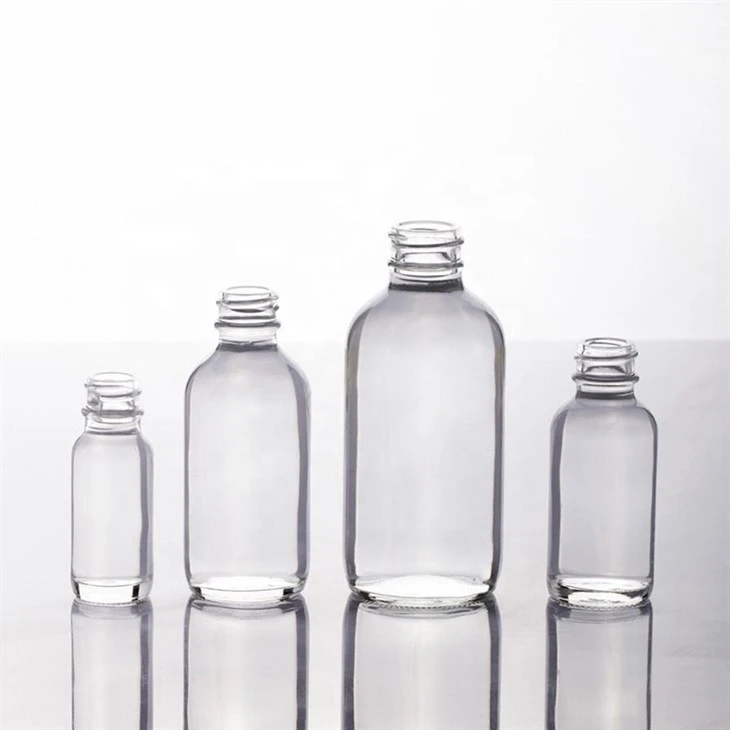
Bottle Design
Some 1ml glass bottles may have features such as flared necks or caps that can increase their overall dimensions and reduce the packing density. For example, if the cap of the bottle adds an extra 5mm to the height, the number of layers that can fit in the box will decrease.
Box Reinforcement
If the box needs to be reinforced for better protection during shipping, such as adding corner protectors or extra layers of cardboard, the internal dimensions of the box will be reduced, which in turn will reduce the number of bottles that can fit inside.
Conclusion
In conclusion, the number of 1ml glass bottles that can fit in a standard box depends on various factors, including the bottle dimensions, packing arrangement, space between the bottles, bottle design, and box reinforcement. Under ideal conditions, using a hexagonal lattice pattern without considering the space between the bottles, we can fit approximately 2760 bottles in a box with internal dimensions of 300mm x 200mm x 150mm. However, in real - world scenarios, accounting for the space between the bottles and other practical considerations, the number may be around 1944 bottles.
If you're in the market for high - quality 1ml glass bottles and need more information on packing and shipping, I encourage you to reach out to us for a detailed discussion. We can work with you to find the most efficient packing solutions based on your specific requirements. Whether you're a pharmaceutical company, a cosmetics brand, or an essential oil producer, our team is ready to assist you in your procurement process.
References
- "Packing Problems" - Mathematical Association of America
- "Shipping and Packaging Guidelines for Glass Containers" - International Safe Transit Association